Advertisement
What Is Email Marketing? A Complete Beginner's Guide
Email marketing is the practice of sending emails to a list of subscribers or customers to promote products or services, share useful content, announce news, nurture leads, retain customers, and drive conversions. In this guide, we explain what email marketing is, how it works, why businesses use it, its main types, and how to start your first campaign step by step.
What Is Email Marketing?
Email marketing is the use of email to communicate with a group of people who have chosen to hear from you. Instead of sending one-off personal messages, a business sends structured, branded emails to a list of subscribers who gave their permission to receive them.
Businesses of all sizes use email marketing to reach the people who matter to them:
- Promote products and services
- Share useful content and educational material
- Announce news, launches, and updates
- Nurture leads toward a purchase
- Retain and re-engage existing customers
- Drive conversions and repeat purchases
The key difference from personal email is purpose and audience. Personal email is a conversation between known individuals. Marketing email is a planned message from a brand to a group of people who opted in, sent through software that manages the list, the design, the delivery, and the results.
Here is a simple example. A clothing store collects email subscribers and then sends:
- A welcome email when someone subscribes
- New product announcements
- Seasonal promotions and discounts
- Abandoned-cart reminders
- A regular newsletter
How Does Email Marketing Work?
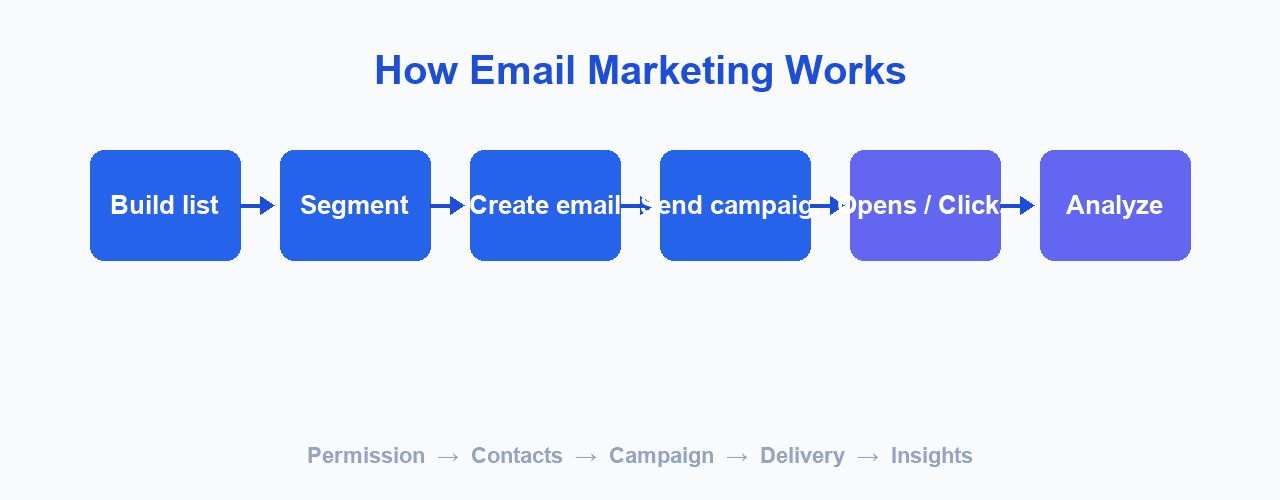
Email marketing follows a repeatable workflow. Once you understand the steps, you can improve each one over time:
- Build an email list of people who gave permission
- Obtain clear permission from each subscriber
- Segment contacts into groups based on behavior or interests
- Create an email with a clear goal
- Choose the right campaign type and audience
- Send the email
- Monitor results such as opens, clicks, and conversions
- Use those insights to improve future campaigns
Visually, the process looks like this:
Subscribers
   → Contact List
   → Campaign
   → Email
   → Delivery
   → Opens / Clicks
   → Analysis
Why Is Email Marketing Important?
Email marketing is important because it gives a business direct, measurable access to its audience:
- Direct communication: Your message lands in a personal channel the receiver chose to use.
- Customer relationships: Email lets you build trust over time with consistent, relevant contact.
- Audience ownership: Your list is an asset you control, unlike followers on a social platform.
- Repeat engagement: You can stay in touch with both new and existing customers.
- Lead nurturing: Email moves prospects closer to a decision with helpful, timely messages.
- Product promotion: You can announce offers and launches directly to interested people.
- Customer retention: Regular, useful emails keep customers coming back.
- Measurable results: You can track opens, clicks, and conversions to see what works.
- Automation: Pre-built sequences can send relevant messages automatically.
- Personalization: You can tailor messages to segments and individual behavior.
Email marketing is not a guaranteed way to make sales. Its value comes from building consistent, relevant communication and measuring what actually works for your business.
What Are the Different Types of Email Marketing?
There are several main categories of marketing email, each with a specific purpose:
Newsletters
Regular content updates sent to subscribers. Newsletters share news, tips, and useful information to keep an audience engaged over time.
Promotional emails
Emails that present offers, discounts, and product promotions. Their goal is usually to drive a specific action such as a purchase or a signup.
Welcome emails
Messages sent automatically after someone subscribes. They introduce your brand, set expectations, and start the relationship on a positive note.
Transactional emails
Order confirmations, receipts, password resets, and account notifications. These are triggered by a user action and are different from marketing emails, even though both may be sent through the same system. Transactional messages provide information that the customer expects; marketing messages promote and build relationships.
Lead nurturing emails
A sequence of messages designed to move prospects toward a purchase. Each email addresses a question or objection and guides the reader forward.
Re-engagement emails
Messages sent to inactive subscribers to bring them back. They might offer something valuable or ask whether the subscriber still wants to receive email.
Event emails
Invitations, reminders, and follow-ups for events, webinars, and launches. They build attendance and keep momentum before and after the event.
Automated email sequences
Predefined sequences that send messages based on subscriber actions or timing. For example, a welcome series, a cart-abandonment sequence, or a post-purchase follow-up.
Email Marketing vs Email Newsletter
Email marketing is the broader concept. A newsletter is one specific type of email marketing. Here is how they compare:
| Email Marketing | Newsletter |
|---|---|
| Broad strategy | Specific recurring format |
| Promotions, automation, nurturing, and more | Usually content or news |
| Can be automated in many ways | Often scheduled regularly |
| Multiple campaign types | Usually one recurring communication |
What Do You Need to Start Email Marketing?
1. A clear goal
Decide what you want the emails to achieve. Common goals include generating sales, acquiring leads, retaining customers, educating subscribers, and promoting content. A clear goal shapes everything else.
2. An email list
You need a list of people who have given permission to be contacted. Build a permission-based list because it leads to better engagement, fewer complaints, and better deliverability. Never buy a list.
3. An email marketing platform
Specialized software makes email marketing practical. A good platform handles:
- Contact management and segmentation
- Campaign creation
- Templates and HTML email support
- Sending and SMTP configuration
- Analytics
- Unsubscribe management
MailCannon is one such tool. You can use it to create and manage email marketing campaigns from a single dashboard.
4. A professional sending setup
To deliver reliably, configure a proper sending domain, a recognizable sender address, and email authentication. Good deliverability depends on how the email is sent and received, not just on what it says. Email authentication is a deeper topic and can be covered separately.
How to Start Email Marketing Step by Step
Step 1 — Define your audience
Know who you are writing to. Understanding your customers and subscribers helps you create messages that are relevant to them. If you have different customer types, plan how you will address each group.
Step 2 — Build your email list
Collect subscribers legitimately. Good sources include:
- Website signup forms
- Checkout or purchase opt-ins
- Lead magnets such as guides, checklists, or discounts
- Events and webinars
- Existing customer relationships, where appropriate
Do not buy email lists. Purchased lists usually contain people who never asked to hear from you. This leads to spam complaints, high bounce rates, and a damaged sender reputation, which makes it harder to reach even your real subscribers.
Step 3 — Choose an email marketing platform
Pick software that supports contact management, campaign creation, HTML email templates, analytics, unsubscribe handling, and SMTP or sending configuration. Look for good deliverability features so your emails actually reach the inbox.
MailCannon provides these tools. You can organize your contacts, build campaigns, use templates, and configure sending from one dashboard.
Step 4 — Create your first campaign
Put together your message. Key parts include a clear subject line, a recognizable sender name and email, focused content, a single clear call to action, and images and links that match your goal. If you need a professional look, you can use a template or build an HTML email template.
Step 5 — Test the email
Send a test before going to your whole list. Check mobile rendering, links, spelling, personalization, the unsubscribe link, and sender information. A careful test prevents embarrassing mistakes.
Step 6 — Send the campaign
Consider your audience's timezone and behavior when you send. Sending at the right time can improve open and click rates.
Step 7 — Analyze the results
Review delivery rate, open rate, click-through rate, bounce rate, unsubscribe rate, and conversion rate. Use what you learn to improve the next campaign.
Email Marketing Best Practices
- Get permission before sending marketing emails.
- Make the sender recognizable.
- Write clear subject lines.
- Keep emails useful and relevant.
- Avoid excessive promotional language.
- Use responsive designs that work on mobile.
- Include a clear call to action.
- Segment your audience.
- Personalize where appropriate.
- Keep contact lists clean.
- Make unsubscribing easy.
- Monitor bounces and complaints.
- Authenticate your sending domain.
- Test emails before sending.
- Respect applicable privacy and email marketing laws.
Legal requirements vary depending on the sender's country and the recipients' location. This list is general guidance and not a substitute for professional legal advice.
Advertisement
Common Email Marketing Mistakes
- Buying email lists. Purchased lists bring uninterested people and harm deliverability. Build your own list instead.
- Sending without permission. Unsolicited email leads to complaints and poor results. Only send to people who opted in.
- Sending too frequently. Too many emails overwhelm subscribers. Choose a sustainable cadence.
- Sending irrelevant content. Emails that miss the reader's interests get ignored. Use segmentation and personalization.
- Using misleading subject lines. Clickbait erodes trust. Make subject lines honest and clear.
- Having no clear CTA. If the reader does not know what to do, they will do nothing. Give one clear action.
- Ignoring mobile users. A large share of email is read on phones. Design for small screens.
- Not cleaning inactive contacts. Inactive subscribers drag down metrics. Re-engage or remove them.
- Ignoring bounce rates. High bounces hurt reputation. Update and validate your list.
- Using a generic "no-reply" address unnecessarily. Replies are valuable and build trust. Use an address people can respond to.
- Not monitoring deliverability. If emails land in spam, results suffer. Watch deliverability and authentication.
- Sending without testing. Untested emails can have broken links or poor rendering. Always test first.
Important Email Marketing Metrics
Delivery rate
The percentage of sent emails successfully delivered to the recipient's server.
Open rate
The percentage of delivered emails that are opened. Open tracking relies on loading an image in the email, so it can have limitations: some recipients block images, and some preview mail without truly opening it. Open rate is a useful signal, but not a perfect measurement.
Click-through rate (CTR)
The percentage of recipients who click a link in the email. Clicking is a stronger sign of interest than opening.
Bounce rate
The percentage of emails that could not be delivered. A hard bounce is a permanent failure, usually because the address does not exist. A soft bounce is a temporary problem, such as a full inbox or a server issue.
Unsubscribe rate
The percentage of recipients who unsubscribe after receiving an email.
Conversion rate
The percentage of recipients who complete the desired action, such as a purchase or signup.
ROI
Return on investment compares the revenue or value a campaign produces with what it cost to run. Tracking conversions lets you see whether your email efforts are worth the time and money.
How Often Should You Send Marketing Emails?
There is no universal ideal frequency. The right cadence depends on your audience, industry, content, expectations, and business model. Some useful examples:
- A weekly newsletter
- Promotional campaigns around specific events and launches
- Automated sequences triggered by user actions
The key is consistency and relevance rather than simply sending more emails. A steady, valuable flow earns trust; a burst of irrelevant messages loses it.
Is Email Marketing Still Effective?
Yes. Email remains an effective channel because of what it does not depend on. It works regardless of changes to social media algorithms, and it reaches an audience that has chosen to hear from you.
- Direct channel: Your message reaches the inbox without third-party platforms.
- Permission-based audience: Subscribers opted in and are more receptive.
- Segmentation: You can tailor messages to different groups.
- Personalization: You can address people by name and behavior.
- Automation: Relevant messages can be sent automatically.
- Measurable results: You can track and improve performance.
Effectiveness depends on how you use the channel. Good lists, relevant content, and sound deliverability produce good results; ignoring these produces poor ones.
Email Marketing and Automation
Automation sends the right message at the right time without manual effort. You can trigger messages based on a signup, a purchase, inactivity, customer actions, dates, or campaign sequences. Here is a simple example:
Subscriber signs up
        ↓
Welcome email
        ↓
Educational email
        ↓
Product email
        ↓
Follow-up
Automation should stay relevant and helpful. Sequences that send too many or irrelevant messages can feel spammy and drive subscribers away.
Email Marketing for Small Businesses
Email marketing is practical for many kinds of small businesses:
- Local businesses: Announce offers, events, and updates to nearby customers.
- Freelancers: Keep clients informed and nurture prospects with helpful content.
- Agencies: Showcase results and build relationships with leads and clients.
- SaaS companies: Onboard users, share product updates, and reduce churn.
- E-commerce stores: Send promotions, abandoned-cart reminders, and post-purchase follow-ups.
- Consultants: Position expertise and stay top of mind with a regular newsletter.
- Content creators: Grow an audience and drive traffic to new content.
No matter the size, the fundamentals are the same: a clear goal, a permission-based list, relevant content, and consistent measurement. For related tactics, see our list of email marketing strategies or read about building a successful email newsletter.
Frequently Asked Questions
What is email marketing?
Email marketing is the practice of sending emails to people who have subscribed, to promote products, share content, nurture leads, and build relationships with an audience that chose to hear from you.
How does email marketing work?
You build a permission-based list, segment it, create an email, send it through a platform, and then measure opens, clicks, and conversions to improve future campaigns.
Is email marketing still effective?
Yes. It is a direct, permission-based channel you control, and it supports segmentation, personalization, automation, and measurement.
How do I start email marketing?
Define your goal, build a permission-based list, choose a platform, create your first campaign, test it, send it, and review the results.
How do I build an email list?
Collect permission through signup forms, opt-ins, lead magnets, events, and existing customer relationships. Do not buy email lists.
What is an email marketing campaign?
A coordinated set of emails sent to a specific audience to reach a goal, such as a promotion, a launch, or a newsletter. It can be a single send or an automated sequence.
What is the difference between email marketing and a newsletter?
Email marketing is the broader practice of using email to reach a goal. A newsletter is one type of email marketing: a recurring content-based communication.
How often should I send marketing emails?
It depends on your audience, industry, content, and business model. Consistency and relevance matter more than volume.
What is the best email marketing software?
The best software depends on your needs, but it should handle contact management, campaign creation, templates, analytics, unsubscribe handling, and sending. MailCannon provides these tools.
Can small businesses use email marketing?
Yes. It works for local businesses, freelancers, agencies, SaaS companies, e-commerce stores, consultants, and content creators.
Conclusion
Email marketing is a direct, measurable way to communicate with an audience that chose to hear from you. It works across many business types and goals, from promoting products to nurturing leads and retaining customers. Start with a clear goal, build a permission-based list, choose a platform that makes the process simple, and improve steadily based on real metrics.
If you are ready to create and manage email campaigns, MailCannon provides tools for managing contacts, creating campaigns, and sending marketing emails from one place. You can also learn to use MailCannon for email marketing or explore the platform for your email marketing needs.
Start Your Email Marketing
Manage contacts, create campaigns, and send marketing emails from one place with MailCannon.
Advertisement