Advertisement
What Is Email Deliverability? A Complete Guide
Email deliverability is the ability of an email sender to get legitimate messages delivered to recipients' intended mailboxes, particularly the inbox rather than the spam or junk folder. Simply having an email accepted by a receiving server does not mean it reaches the inbox. In this guide, we explain what deliverability is, how it differs from delivery, and how to improve it.
What Is Email Deliverability?
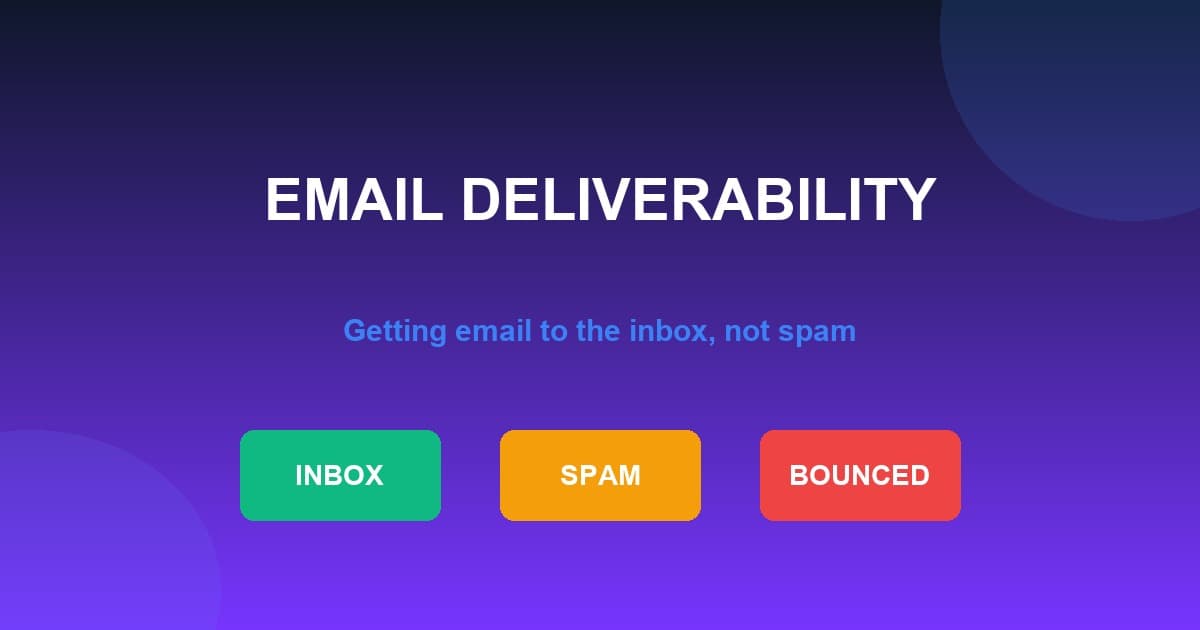
Deliverability is how successfully your email reaches the place a recipient expects to find it — the inbox. It matters because an email that is accepted but lands in spam is effectively not seen. Consider a simple example:
You send 10,000 emails. Some may:
- Reach the inbox
- Reach the spam or junk folder
- Bounce (fail to deliver)
- Be rejected entirely
Deliverability focuses on how successfully legitimate email reaches its intended destination. It is central to email marketing because a campaign only works if readers actually see it.
Email Delivery vs Email Deliverability
Delivery and deliverability are related but different. Delivery is about transmission; deliverability is about final placement.
| Email Delivery | Email Deliverability |
|---|---|
| Whether the receiving server accepts the email | Where the email ultimately lands |
| Focuses on successful transmission | Focuses on inbox placement |
| Includes accepted messages | Includes inbox vs spam/junk behavior |
| Primarily technical | Technical + reputation + engagement |
An email can be technically delivered yet still end up in spam. That is why tracking deliverability is more meaningful than tracking delivery alone.
Why Is Email Deliverability Important?
Businesses care about deliverability because it directly affects how email performs:
- More subscribers actually see your campaigns
- Better overall campaign performance
- A better sender reputation over time
- Less wasted effort sending email that is never seen
- Fewer bounces
- Fewer spam complaints
- More reliable customer communication
- More predictable email campaigns
What Determines Email Deliverability?
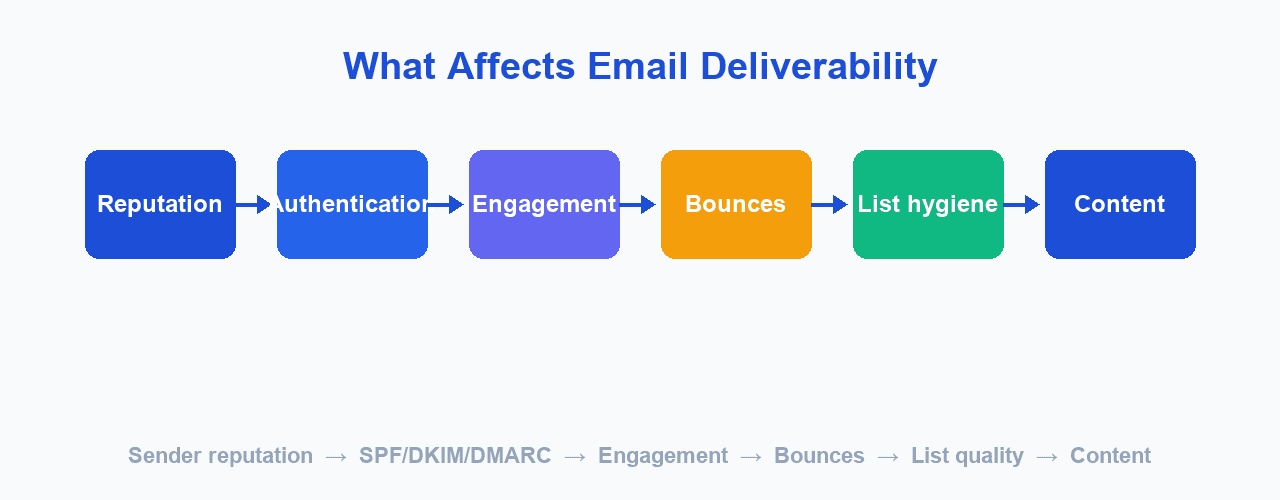
Many factors together decide where your email ends up:
- Sender reputation: how providers judge your sending history
- Domain reputation: the standing of the domain you send from
- IP reputation: the standing of the IP address used for sending
- Email authentication: SPF, DKIM, and DMARC verification
- Recipient engagement: opens, clicks, and replies
- Bounce rates: how often delivery fails
- Spam complaints: how often recipients mark you as spam
- List quality: the health of your recipient list
- Sending consistency: steady, predictable patterns
- Email content: relevance and honesty of the message
- Links and domains: the destinations you link to
- Recipient expectations: whether the mail is wanted
Sender Reputation
Sender reputation reflects how providers view your overall sending behavior. It is shaped by your historical sending, bounce rates, spam complaints, engagement, authentication, and sending patterns.
Reputation is built over time through consistent, responsible sending. There is no single universal score that always determines placement; providers consider your history in context.
Domain Reputation
Domain reputation is the standing of the domain you send from. Because it follows the domain rather than a single server, it moves with you even if you change IPs. Using your sending domain consistently helps providers associate your mail with a clear, known identity.
Poor sending practices can damage a domain's reputation, and that damage can be hard to undo. Domain reputation is closely related to IP reputation, but they are not the same thing: a domain refers to your address namespace, while an IP refers to the specific server used to send.
IP Reputation
IP reputation is the standing of the internet address that sends your mail. In simple terms:
- Shared IPs: many senders use the same IP. Your reputation is partly influenced by others sharing it.
- Dedicated IPs: you send from an IP used only by you, so its reputation reflects your behavior alone.
The importance of IP reputation can vary depending on your sending setup and provider. For many email marketing platforms, domain reputation and authentication matter more than the specific IP.
SPF, DKIM, and DMARC
Authentication lets providers verify that an email really comes from the domain it claims to. The three main mechanisms are:
SPF
SPF lets a domain specify which servers are authorized to send email on its behalf.
DKIM
DKIM adds a cryptographic signature that receiving systems can use to verify the message was authorized and not improperly altered.
DMARC
DMARC lets domain owners define how receiving systems should handle messages that fail authentication, and provides reporting about how the domain is used.
| Technology | Main purpose |
|---|---|
| SPF | Identifies authorized sending servers |
| DKIM | Authenticates messages using a digital signature |
| DMARC | Defines policy and reporting around authentication |
Authentication is a crucial part of deliverability, but it does not guarantee inbox placement on its own. It works alongside reputation, list quality, and content.
Bounce Rate and Email Deliverability
A hard bounce is a permanent delivery failure, for example an invalid address or a non-existent domain. A soft bounce is a temporary failure, such as a full mailbox, a temporary server issue, or a temporary rejection.
Consistently sending to invalid addresses can hurt your list quality and reputation. Providers notice high bounce rates, so keeping your list clean and removing known-failure addresses is important.
Spam Complaints
When recipients mark your messages as spam, providers treat that as a strong negative signal. High complaint rates can lower your sender reputation and increase the chance your mail is filtered.
You can reduce complaints by:
- Sending only relevant content
- Using recognizable sender information
- Setting clear expectations during signup
- Avoiding excessive frequency
- Making unsubscribing easy
Recipient Engagement
Provider systems pay attention to how recipients interact with your mail, including opens, clicks, replies, deletes, spam reports, and ignoring messages. Engaged recipients support good deliverability; a large share of disengaged recipients can hurt it.
Open tracking is imperfect because of privacy technologies, so do not treat open rate as a perfect measure. Focus on engagement as a broader set of behaviors rather than a single number.
Email List Hygiene
Good list management keeps your deliverability healthy:
- Remove invalid addresses
- Process unsubscribes promptly
- Monitor hard bounces
- Monitor repeated soft bounces
- Segment inactive users
- Re-engage where appropriate
- Suppress recipients who should no longer receive marketing emails
Never buy or scrape lists. A clean, permission-based list is the foundation of good deliverability.
Sending Frequency and Consistency
There is no universal perfect sending frequency. What matters is that your sending matches subscriber expectations, your content type, your business model, and what you promised at signup.
Sudden, unexplained changes in sending patterns can be problematic, because providers expect reasonably consistent behavior. Stay steady and predictable rather than making abrupt changes.
Email Content and Deliverability
Content is one factor among many. Relevance, accurate subject lines, a clear sender identity, useful content, legitimate links, good HTML, mobile-friendly design, accessible content, and appropriate image use all contribute.
Avoid outdated myths such as "using a certain spam word automatically sends your email to spam." Modern filtering systems consider many signals together, not a single keyword.
Why Do Legitimate Emails Go to Spam?
Even legitimate senders can experience spam placement. Possible reasons include poor sender reputation, authentication problems, high complaint rates, poor list quality, low engagement, sending behavior, content or link reputation, and receiving-provider policies.
For a deeper look at diagnosing the problem, read more about why emails go to spam.
Advertisement
How to Improve Email Deliverability
Step 1 — Use permission-based lists
Only send to people who opted in and expect your mail.
Step 2 — Authenticate your domain
Configure SPF, DKIM, and DMARC for your sending domain.
Step 3 — Keep your contact list clean
Remove invalid addresses and keep your list up to date.
Step 4 — Monitor bounces
Watch for hard and soft bounces and act on them.
Step 5 — Monitor spam complaints
Keep complaint rates low by matching expectations.
Step 6 — Send relevant content
Give subscribers useful, honest messages they value.
Step 7 — Maintain a consistent sending pattern
Send steadily and avoid sudden, unexplained volume changes.
Step 8 — Make unsubscribing easy
Provide a clear unsubscribe path so people leave instead of complaining.
Step 9 — Test emails before sending
Check rendering, links, and content before a full send.
Step 10 — Monitor campaign performance
Track metrics and learn from results to improve the next campaign.
How to Measure Email Deliverability
Useful indicators include delivery rate, bounce rate, hard and soft bounce rates, spam complaint rate, unsubscribe rate, engagement, inbox placement (where measurable), and conversion rate.
| Metric | What it tells you |
|---|---|
| Delivery rate | How many emails were accepted for delivery |
| Bounce rate | How many emails failed to deliver |
| Complaint rate | How often recipients report messages as spam |
| Unsubscribe rate | How often recipients opt out |
| Click-through rate | How many recipients click links |
| Conversion rate | How many recipients complete the desired action |
Metrics should be evaluated together rather than in isolation. A single number rarely tells the full story.
What Is a Good Email Deliverability Rate?
There is no single universal benchmark. What counts as "good" depends on your sending type, audience, industry, provider, list quality, and sending infrastructure.
Rather than chasing one arbitrary number, track your own trends over time, watch for rising bounces or complaints, and compare your performance across providers. If you use external statistics, verify them with reputable, current sources.
Email Deliverability Best Practices
- Use permission-based contacts
- Authenticate your domain
- Keep lists clean
- Monitor bounces
- Monitor complaints
- Use recognizable sender information
- Send relevant content
- Segment audiences
- Maintain consistent sending
- Test emails
- Make unsubscribing easy
- Monitor reputation
- Monitor campaign metrics
How Email Marketing Platforms Can Help With Deliverability
An email marketing platform can support deliverability by helping with the mechanics of sending and monitoring. Legitimate functionality includes contact management, campaign management, list segmentation, template management, sending configuration, bounce monitoring, campaign analytics, and unsubscribe management.
Email Deliverability With MailCannon
MailCannon helps you organize and manage email campaigns, contacts, and sending workflows. It provides tools for contact management, campaign creation, HTML templates, SMTP configuration, sending, and monitoring.
Using an email marketing platform does not automatically guarantee inbox placement. Deliverability still depends on recipient permission, list quality, domain authentication, sender reputation, content, sending practices, and receiving-provider policies. MailCannon handles the campaign tools and sending workflow; a healthy list and domain remain your responsibility.
To get started, learn how MailCannon supports email marketing campaigns, or keep your contacts organized with clean, well-managed lists.
Frequently Asked Questions
What is email deliverability?
Email deliverability is the ability of a sender to get legitimate messages into recipients' intended mailboxes, especially the inbox rather than spam or junk. It is about final placement, not just acceptance.
What is the difference between email delivery and deliverability?
Delivery means the receiving server accepted the message. Deliverability means the email reached the intended place, such as the inbox. An email can be delivered yet still end up in spam.
Why is email deliverability important?
Good deliverability means more subscribers actually see your campaigns, which improves performance, protects your reputation, and reduces bounces and complaints.
How can I improve email deliverability?
Use permission-based lists, authenticate with SPF, DKIM, and DMARC, keep lists clean, monitor bounces and complaints, send relevant content, and send consistently.
Does SPF improve email deliverability?
SPF helps providers verify an authorized server sent the message, which supports deliverability, but it does not guarantee inbox placement on its own.
Does DKIM improve deliverability?
Yes. DKIM verifies a message was not improperly altered and helps establish you as a legitimate sender, supporting better deliverability alongside SPF and DMARC.
Does DMARC improve deliverability?
DMARC defines how failed authentication is handled and provides reporting. It protects your domain and supports deliverability, but it is not a guarantee of inbox placement.
What causes poor email deliverability?
Poor deliverability usually comes from a combination of weak reputation, missing authentication, high bounces or complaints, poor list quality, low engagement, and inconsistent sending.
What is a good email deliverability rate?
There is no single universal benchmark. It depends on your sending type, audience, industry, provider, and list quality. Track your own trends rather than one arbitrary number.
How can I monitor email deliverability?
Monitor delivery rate, bounces, spam complaints, unsubscribes, engagement, and conversions together, and watch for trends and provider-specific differences.
Conclusion
Email deliverability is about getting legitimate email to the inbox rather than spam or junk. It is shaped by sender reputation, authentication, engagement, bounces, complaints, list quality, and responsible sending. Good deliverability is built steadily through clean lists, proper domain configuration, and consistent, relevant communication.
To go deeper, start with our guide to what email marketing is, learn how to send bulk emails without going to spam, and understand why emails go to spam.
Start Managing Your Email Campaigns
Manage contacts, build campaigns, and send marketing email from one dashboard with MailCannon.
Advertisement